
Class 12Chemistry8-2.Carboxylic acids and Their derivativeMix Examples-Carboxylic acids and Their derivative
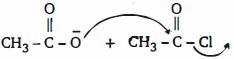
DifficultThe reaction of sodium acetate with acetyl chloride proceeds through which of the following mechanisms?
- A
- B
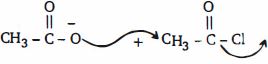
- C
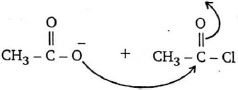
- D
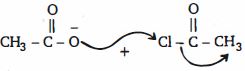
Explore More
Similar Questions
The product $D$ of the reaction is:
$CH_3Cl$ $\xrightarrow{KCN} (A)$ $\xrightarrow{H_2O} (B)$ $\xrightarrow{NH_3} (C)$ $\xrightarrow{\Delta} (D)$
$CH_3Cl$ $\xrightarrow{KCN} (A)$ $\xrightarrow{H_2O} (B)$ $\xrightarrow{NH_3} (C)$ $\xrightarrow{\Delta} (D)$
Medium
View SolutionThe final product $[D]$ of the reaction is
$CHCl_3$ $\xrightarrow[hv]{O_2} [A]$ $\xrightarrow{EtOH} [B]$ $\xrightarrow{2 \ mole \ MeMgBr} [C]$ $\xrightarrow{CaOCl_2} [D]$ $\xrightarrow{\Delta} CH_3-C(=O)-CH_3$
$CHCl_3$ $\xrightarrow[hv]{O_2} [A]$ $\xrightarrow{EtOH} [B]$ $\xrightarrow{2 \ mole \ MeMgBr} [C]$ $\xrightarrow{CaOCl_2} [D]$ $\xrightarrow{\Delta} CH_3-C(=O)-CH_3$
The reagent$(s)$ required for the following conversion are:
DifficultJEE MAIN 2018
View SolutionStatement $(A)$: Carboxylic acid can be obtained by the reaction of $R-C \equiv N$ with $H_3O^+$ under mild reaction conditions.
Statement $(B)$: Hydrolysis of $R-C \equiv N$ in alkaline aqueous medium gives $R-COONa$ and $NH_3$ as products.
The correct answer is:
Statement $(B)$: Hydrolysis of $R-C \equiv N$ in alkaline aqueous medium gives $R-COONa$ and $NH_3$ as products.
The correct answer is:
DifficultTS EAMCET 2019
View SolutionThe product $(A)$ of the reaction is:
Difficult
View SolutionVedclass Products
For Students
Vedclass Test Series
Mock tests in real JEE/NEET style with performance analysis. 5-day free trial.
Start Free TrialFor Teachers
Exam Paper Generator
Generate Set A/B/C/D exam papers from 7.5L+ questions in 2 minutes. 3 chapters free.
Try FreeFor Institutes
Online Exam Module
Live online exams with unlimited students, 360° analytics & white-label branding.
See Demo